

GamingPizza is supported by our readers. When you buy products through links on our site, we may earn an affiliate commission.
A PS5 code was provided to GamingPizza for this review. Scar-Lead Salvation is available now on PS4, PS5, Xbox X|S, and PC via Steam.
I’ll be honest… I have a bit of a love/hate relationship with roguelikes. The “Live. Die. Repeat.” formula can definitely be fun when executed well, but it’s also a genre that can be susceptible to lazy and repetitive design choices… which is kind of the point too, I suppose, but there are arguably ways to do it right.
When a game leans too heavily on the procedural generation and permadeath mechanics without building meaningful systems around them, you end up with games that feel more like grinding than genuine progression. So when Compile Heart announced they were stepping away from their more traditional anime RPG comfort zone to tackle a third-person shooter roguelike with Scar-Lead Salvation, I was… you guess it: cautiously optimistic.
Here was a chance for a studio known for niche titles to prove they could innovate beyond their established formula.
Unfortunately, after spending time with main character Willow Martin’s repetitive escape from a sterile military facility, I’m left with that familiar roguelike disappointment. It’s the nagging sense that this could have been something much more substantial, perhaps being better suited as an action RPG.
The Setup Shows Promise

Scar-Lead Salvation introduces us to Willow, an amnesiac woman trapped in a mysterious military complex filled with robotic enemies. She’s accompanied by an AI companion whose dry, sometimes sarcastic commentary provides the game’s strongest narrative element.
The dialogue system is well done, which I ultimately expected from Compile Heart. Willow’s conversations with her AI companion strike a nice balance between exposition and character development, with voice acting that brings genuine life to what could have been generic sci-fi banter (or no dialogue at all).
Related: The Fox’s Way Home Review: A Deceptively Simple, Moonlit Puzzle
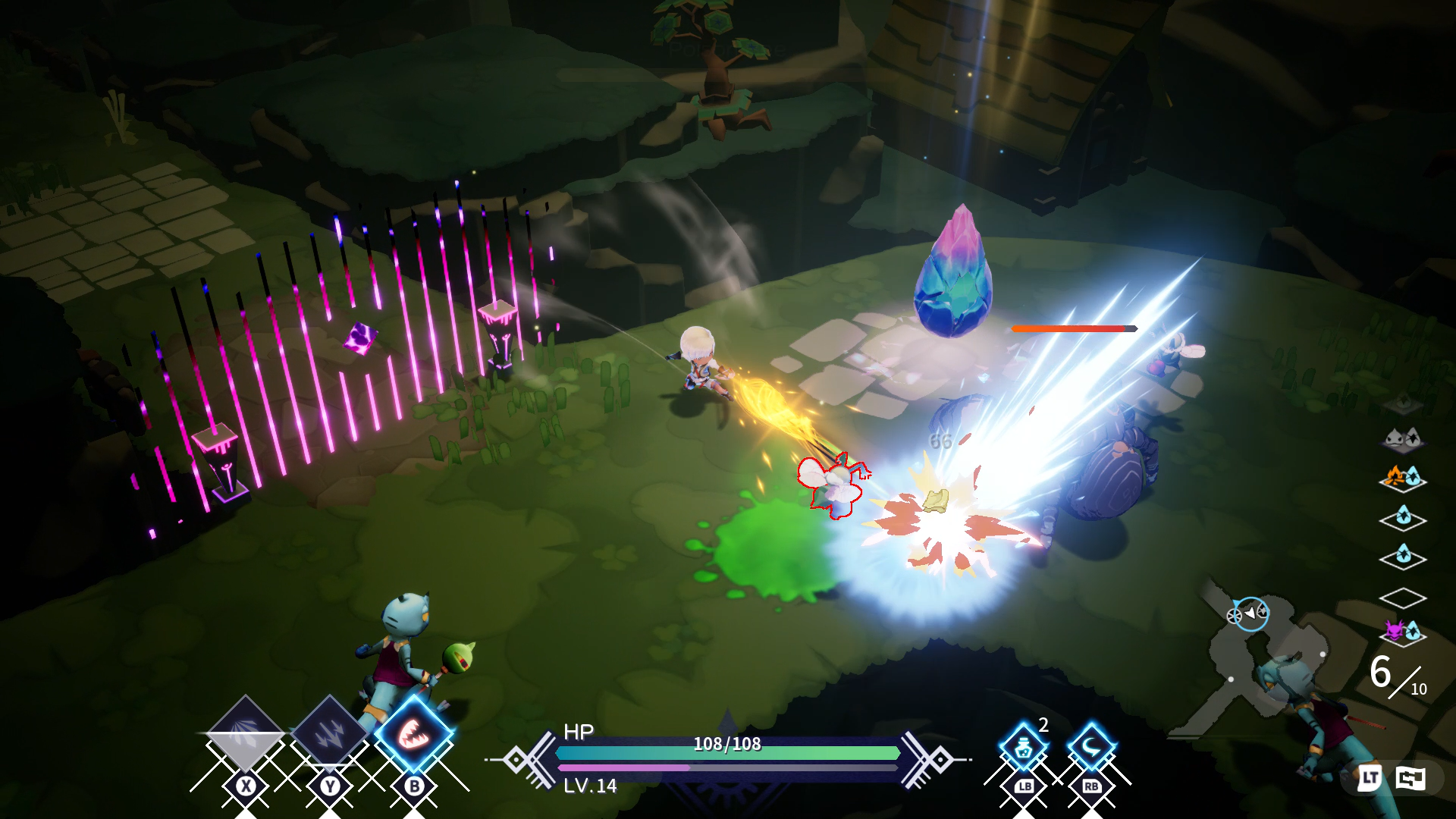
The core shooting mechanics are fine, if not overly simplistic. Willow moves with decent responsiveness, her dodge mechanics feel tight, and the variety of weapons (from standard rifles to elemental-based firearms) provides some tactical considerations during combat encounters. Her melee attack was my favorite, and easily most used weapon, though. Maybe because of its tactical prowess… or maybe because it was wildly overpowered. (This is NOT a complaint.)
The bullet-hell elements also work as intended, requiring you to weave through enemy fire while managing your own offensive strategy.
Where the Formula Scars a Bit

Here’s where my roguelike skepticism kicks in, and Scar-Lead Salvation does little to alleviate those concerns. After the initial novelty wears off (in about the first 45-or-so minutes), the game’s design flaws become a bit hard to ignore.
The environments are the biggest culprit. While the initial military facility aesthetic is clean and functional — making me oddly nostalgic from my Phantasy Star Online days from a million years ago — the procedural generation feels more like room rearrangement than actual variety. You’ll encounter the same basic layouts repeatedly: sterile corridors, combat arenas with minimal cover variation, item rooms, and boss chambers. The game attempts to differentiate areas with different visuals, like frost-covered walls, industrial metal, and other Sci-Fi aesthetics, but the underlying structure remains very similar throughout.
Enemy variety has the same problem. The robotic adversaries look good, but their behavioral patterns become predictable quickly. By the third or fourth floor, you’ve essentially seen everything the game has to offer in terms of combat encounters. The game’s difficulty also makes most encounters feel redundant. I’m certainly no proponent of the “play only on Hard difficulty only” mentality, but the lack of any substantial challenge (even on Normal difficulty) ultimately lends itself to being boring.
Roguelikes live or die based on how they handle the balance between permanent progression and run-based improvements. The best games in the genre make each death feel like a learning experience while gradually building toward meaningful character advancement.
Scar-Lead Salvation misses this mark. There’s no skill tree to unlock new abilities, no meaningful meta-progression to make subsequent runs feel different, and the passive upgrades you can carry between attempts don’t really change how you approach the game — at least, they didn’t for me. Not at all. Each run feels pretty much the same as the last, with only minor stat adjustments differentiating your capabilities.
The Action RPG That Could Have Been

This is where I keep returning to the thought that Scar-Lead Salvation would have worked better as a traditional action RPG. The foundation is clearly there with interesting characters, a mystery worth unraveling, solid basic combat mechanics, and a setting that feels like it could definitely support a more structured narrative experience.
Instead of procedurally generated floors, it feels like we could have had carefully crafted levels that allowed for proper pacing and environmental storytelling, along with a progression system that let you meaningfully customize Willow’s abilities and combat style over the course of a 15-20 hour campaign. Maybe this is too tall of an ask. It just feels like the roguelike component is too half-baked with ideas that could have been so much more.
Technical Competence Meets Creative Stagnation
Scar-Lead Salvation feels like a game built around checking genre convention boxes rather than exploring what makes roguelikes engaging in the first place. The procedural elements feel mandatory rather than a driving force, and the permadeath mechanics seem included because that’s what roguelikes are “supposed to have,” not because they serve the game’s core design.
Scar-Lead Salvation isn’t broken, but it’s not really inspired either. It feels a safe, middle-of-the-road approach to game design that will likely satisfy no one completely. Roguelike enthusiasts will likely find the progression systems too shallow and the procedural elements too repetitive. Action game fans will be frustrated by the lack of meaningful character advancement or a general change of scenery.
For all my reservations about the roguelike genre’s tropes, I’ve seen enough examples to know that the formula can work well when the cycle of death and revival keeps you playing. Scar-Lead Salvation, unfortunately, seems to understand the mechanics without going all-in on anything.
There’s a decent game buried somewhere in here, but it feels like it’s fighting against its own design choices to emerge. Compile Heart deserves credit for attempting something outside their usual wheelhouse, but the execution suggests they might have been better served sticking to what they know best… or committing more fully to understanding what makes their chosen genre tick.
Next: The Fox’s Way Home Review: A Deceptively Simple, Moonlit Puzzle